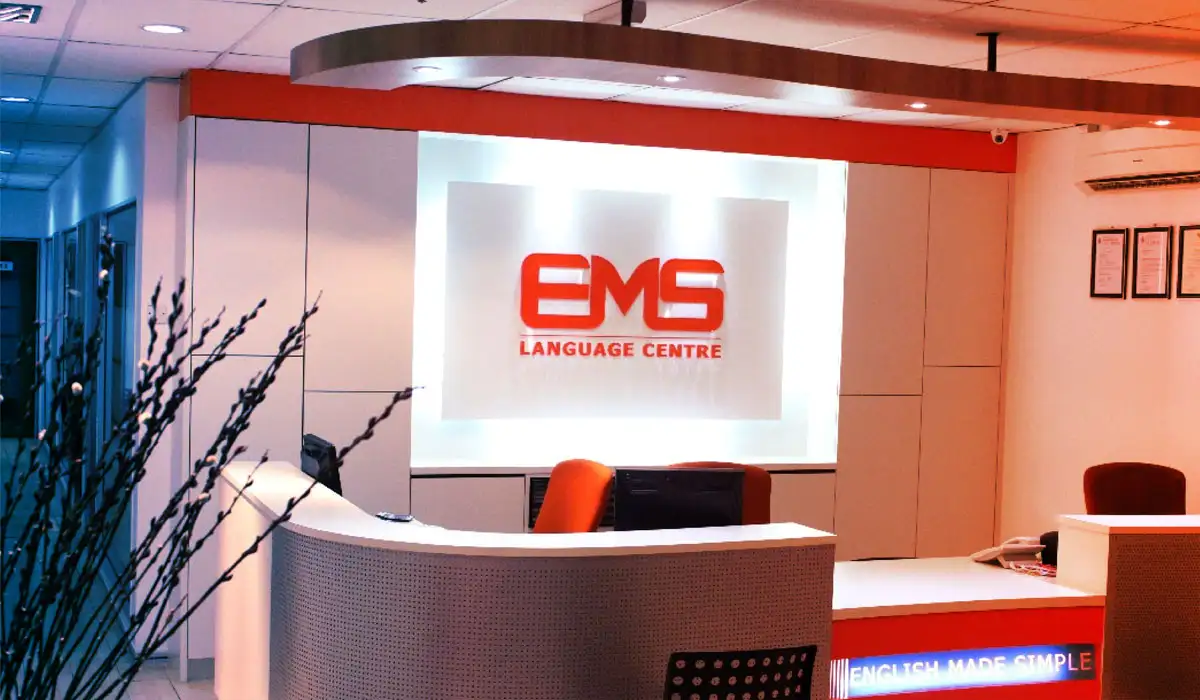

By Yulia Karmanova, English teacher at EMS Language Centre
The right English speaking class in Kuala Lumpur is the one where you personally speak the most minutes per hour, in a small mixed-nationality group, with a teacher who corrects you while you talk. Brochures and buildings matter far less than that. Price, location and timetable still decide what is realistic, so this guide covers the options across KL, the six things to check before you pay, and the questions that get a straight answer out of any centre.
If you have already settled on a centre rather than a tutor or an app, our guide to choosing an English language centre covers accreditation, visas and location. This article stays on one thing: speaking.
The Options in Kuala Lumpur
Searching for english speaking classes near me in KL turns up four different products at four different prices. They are not interchangeable, and the cheapest is not always the worst one for a specific problem.
| Option | Your speaking time | Correction you get | How it is usually priced | Best for |
|---|---|---|---|---|
| Language centre, group class | Depends on class size | Trained teacher, in the moment and after | Per month or per level, plus registration and materials | Structured progress and placement by level |
| Private tutor | Highest per hour, you are the only student | Varies with the tutor’s training | Hourly, sometimes in prepaid blocks | An exam, an interview, a presentation |
| Apps and online conversation practice | High, but scripted | Pronunciation and grammar flags only | Monthly subscription | Daily drilling between classes |
| Free meetups and exchange groups | Unpredictable, depends who turns up | None you can rely on | Free, or a coffee | Losing the fear of speaking |
Language Centres
A centre sells you structure: placement at a level, a syllabus, the same teacher and classmates for a stretch of weeks, and someone accountable for whether you improve. KL centres cluster around the city centre and the student areas, so most are reachable on the LRT, MRT or Monorail without a car.
The variable that decides everything is class size, and it is the thing centres are least likely to print. A group of six and a group of twenty are sold with the same words and are not the same course. Our EMS Speaking Course page sets out how the classes are organised, and the class size question below is the one to put to us and to every centre you shortlist.
Private Tutors
One to one is the most speaking time money can buy. For an interview next month or one stubborn pronunciation problem, a good tutor is hard to beat.
Two things to watch. The hourly rate means most learners book one or two sessions a week, which is less total practice than a group course running several days a week. And anyone can call themselves an English tutor, so ask about qualifications the way you would at a centre. A fluent speaker is not automatically a teacher.
Apps and Online Conversation Practice
Apps are good at the parts of language that respond to repetition: vocabulary, listening, individual sounds, grammar you can see on a screen. They are cheap, available at midnight, and used daily they genuinely help.
What they cannot do is interrupt you. A real conversation goes wrong in ways an app does not simulate: someone talks over you, you lose the word you needed, you repair the sentence while five people wait. Treat an app as homework for a speaking class, not a replacement for one.
Free Meetups and Exchange Groups
KL has language exchange meetups, community groups and conversation circles, and they cost nothing. They are excellent for the psychological part of speaking: getting used to being heard in English.
Their weakness is that nobody corrects you, and mistakes you repeat for a year become permanent. Most learners who improve quickly use both: a class where errors get fixed, and a meetup where practice is free and pressure is low.
The One Number That Matters: Your Speaking Minutes
Here is the arithmetic almost nobody does before enrolling, and it settles most comparisons on its own.
Take a 60 minute class. Subtract the time the teacher spends explaining, plus the time on listening tracks and reading from a book. Divide what is left by the number of students. That is your speaking time.
Two imaginary classes make the point. In the first, a class of twenty, the teacher talks for 25 minutes and the rest is whole-class question and answer: share 35 minutes twenty ways and you speak for under two. In the second, a class of eight, the teacher talks for 15 minutes and the other 45 go to pairs and small groups, where half the class is speaking at any moment. Your share is over 20 minutes.
Same hour. Same price range. Ten times the practice.
So do not ask a centre whether the class is communicative. Every centre says yes. Ask how many students are in the room and how an hour is divided, then do the division yourself.
Six Things to Check Before You Enroll
Ask all six and you will know more about a centre than most of its enrolled students do.
Class Size
Ask for the maximum, not the average. Averages hide the full classes, and a cap is a promise while an average is a statistic. Good looks like: a stated maximum, small enough that every student speaks in every lesson.
How Speaking Time Is Divided
Ask what a typical hour looks like, minute by minute. Pair and small group tasks multiply practice because several students speak at once, while whole-class question and answer puts one student on and everybody else on pause. Good looks like: most of the hour in pairs or small groups.
Whether Correction Actually Happens
Ask how and when you are corrected. Some teachers interrupt, some note errors and go through them at the end, and the best do both depending on the task. What matters is that it is deliberate. Good looks like: a teacher who can describe their own correction method without hesitating.
Levels, and How You Are Placed
Ask how they decide your level and whether the test includes speaking. A grammar quiz on paper sorts readers, not speakers, and plenty of learners read well above the level they can talk at. Good looks like: a placement check with a spoken component, and a clear path from your level to the next one. You can start with the free placement test before you commit to anything.
If your target is a university place, say so at placement: exam preparation is a different course from general speaking. Our guide to what IELTS band score you need in Malaysia covers that case.
The Nationality Mix in the Room
Ask who else is in the class. If everyone shares your first language, the class will drift into it the moment a task gets difficult, and English becomes the thing you do only when the teacher is listening. Good looks like: a class where English is the only shared language, so it is used by necessity rather than instruction.
Teacher Qualifications and Experience
Ask what qualifications the teachers hold and how long they have taught. Teaching speaking is a trained skill: setting up tasks, managing pair work, correcting without killing the conversation. Good looks like: recognised teaching qualifications, named when you ask, and experience with learners at your level.
Red Flags
Classes Where the Teacher Talks Most
A teacher lecturing about English is the clearest sign you are in the wrong room. It feels productive, because the explanation is clear and you follow every word, and you still leave having spoken for one minute. In a trial class, time how long the teacher holds the floor.
Everyone Shares Your First Language
This one is comfortable, which is why it is a problem. The group has a working alternative to English and will use it under pressure. If every classmate comes from your country, expect your speaking to lag behind your reading.
No Placement Test
A centre that puts you in a class without assessing you is organising by timetable, not by level, and you end up either bored or lost. If the answer to “how will you decide my level” is “just come on Monday”, treat that as the answer to several other questions too.
What Speaking Classes Cost in Kuala Lumpur
Advertised prices across KL are not comparable until you reduce them to the same shape, because centres bill in different units. Before comparing two numbers, check which of these you are being quoted.
- The billing unit. Per week, per month, per level or per full course. A per-level fee without the number of weeks in a level tells you nothing.
- Hours per week. Work out the cost per contact hour, then divide again by class size for the cost per hour of your own speaking time.
- Registration. Usually one-time, sometimes quoted separately from tuition, occasionally not quoted until you enrol.
- Materials. Books and online access may be bundled or billed on top, and may recur at each new level.
- Payment schedule. Paying monthly rather than for a whole level up front changes what you risk if the class turns out to be wrong for you.
- Extras for international students. Visa processing, insurance or administration charges, where they apply to you.
For EMS Speaking Course fees, ask us for a quote broken down the same way: tuition and the unit it is billed in, registration, and materials. The contact page is the quickest way to get that in writing, and a quote in that shape can be compared line by line against any other centre on your list.
One warning about cheap classes. A low monthly fee in a class of twenty-five can cost more per minute of your own speaking time than a higher fee in a class of eight. Run the division before deciding which is expensive.
Why International Students Pick EMS for Speaking
EMS is an English language centre in Kuala Lumpur, and the students in a given speaking class come from several different countries. That mix is the practical reason speaking improves here: when the person next to you does not speak your first language, English stops being an exercise and becomes the only way to get the task done.
The other reason is placement. Every learner starts with a placement check rather than a guess, so you join a class where the tasks stretch you without silencing you. Students who arrive after a stalled app subscription usually find the difference is simply that someone is now correcting them.
Some details are worth getting from us directly rather than from a brochure, because they move between intakes. Ask for the maximum class size on the course you would join, the qualifications and teaching experience of the staff who would teach you, how many levels the course runs to and how many hours a week each level involves, the current timetable and the next intake date, and how to reach the centre on public transport. The Speaking Course page covers how the course is organised, and the contact page is where to send the rest.
Try a Speaking Class at EMS
Compare on the four things that decide results: how many students are in the room, how much of the hour you spend talking, whether anyone corrects you, and who else is sitting there. Ask us, and ask every other centre on your list the same questions.
Start with the EMS Speaking Course page, then take the placement check so your first class is at the right level. If you would rather see a class in progress before committing, ask the team on the contact page what can be arranged.
Register now to apply for your place.
Already enrolled, or practising on your own first? Use this daily English speaking routine, and see what two hours inside an EMS speaking class looks like.
If speaking is the part that freezes, read why you can understand English but cannot speak it first.
Frequently Asked Questions
How much do English speaking classes cost in Kuala Lumpur?
Fees vary by centre, class size and course length, and the headline number is rarely the total. Most centres bill per month or per level, then add registration and materials. Always convert a quote to cost per contact hour, then divide by class size. For an EMS quote in that form, ask the team through the contact page.
Are group classes or private tutors better for speaking?
Group classes for general fluency, a private tutor for a deadline. A small mixed group gives you unpredictable conversation with real people at a lower cost per hour. A tutor gives you maximum speaking time and focused attention, which suits an interview, an exam or one specific weakness.
Can I improve my speaking with an app alone?
Only partly. Apps build vocabulary, listening and pronunciation of individual sounds through daily repetition, and that is real progress. What they cannot replicate is a live conversation that goes wrong: being interrupted, losing a word, repairing a sentence under pressure. Use an app alongside a class, not instead of one.
How do I know my level before joining?
Take a placement test, and check that it assesses speaking rather than only grammar on paper. Many learners read a level or two above the level they can talk at, so a written-only result can put you in the wrong class. EMS places every student after a placement check rather than by request.
How long before my speaking improves?
Confidence usually shifts before accuracy does, so the first change you notice is being willing to start a sentence. Accuracy follows more slowly and depends mostly on practice volume and whether errors get corrected. Rather than guessing, record yourself answering the same question at the start and again later.
About the author
Yulia Karmanova teaches English at EMS Language Centre in Kuala Lumpur. She holds a PhD in Linguistics and a Master’s Degree in Teaching English, Literature and Translation, and has 17 years of classroom experience.