By Yulia Karmanova, Head of the IELTS Department at EMS Language Centre
Before joining a speaking class, most students want to know one thing: what will I actually do for two hours?
At EMS Language Centre in Kuala Lumpur, the Speaking Course is designed around active use of English. EMS currently offers the course for Elementary, Pre-Intermediate and Intermediate learners, with two-hour daily classes. The exact order of activities can vary by lesson and level, but the purpose stays the same: give students repeated opportunities to speak, respond, think in English and receive useful feedback.
This walkthrough shows what that experience looks like in practice, based on the activities and teaching approach EMS publishes for its Speaking Course.
BEFORE THE CLASS: LEVEL AND PLACEMENT
A speaking class works best when the challenge matches the learner. If the language is far above your level, you spend the lesson trying to understand. If it is too easy, you do not stretch your vocabulary, fluency or accuracy.
EMS uses placement testing to help identify a suitable starting level. The Speaking Course itself is currently described for Elementary, Pre-Intermediate and Intermediate students. That gives teachers a clearer range of language to expect and helps activities stay useful rather than overwhelming.
If you are unsure about your level, start with the EMS placement test: https://ems.edu.my/ems-placement-test/
THE OPENING: WARM-UP AND CONVERSATION
A speaking lesson needs an easy entry point. Rather than beginning with a long lecture, a useful warm-up gets students talking about a familiar question, recent experience or simple opinion.
The goal is not to produce perfect sentences immediately. It is to switch into English, activate vocabulary and reduce the hesitation that often appears at the beginning of a conversation.
For a nervous learner, this stage matters. A short exchange with a partner or small group can make the rest of the lesson feel much more manageable.
THE CORE OF THE CLASS: ACTIVITIES THAT REQUIRE REAL SPEAKING
The centre of the lesson is active communication. EMS lists discussions, question-and-answer sessions, critical-thinking tasks, role-plays, presentations, pronunciation and fluency practice, and situational dialogues among its Speaking Course activities.
Discussions and Question-and-Answer Activities
Discussion gives you practice doing something real conversations demand: forming an opinion, explaining it, listening to another person and responding. A good speaking task does not end after one prepared sentence. It creates follow-up questions and reasons to clarify what you mean.
Role-Plays and Situational Dialogues
Role-play lets you rehearse situations before you face them outside class. You might practise asking for information, solving a problem, making a request, handling a misunderstanding or responding politely when you disagree.
Situational practice is useful because fluency is not only knowing vocabulary. It is being able to access the right language when the situation changes.
Presentations
Presentations train a different kind of speaking: organising ideas, speaking for longer without interruption, using signposting language and staying understandable while people are listening to you.
Not every presentation needs to be formal. Short individual or group speaking tasks can build the same skills without turning every lesson into a high-pressure performance.
Pronunciation and Fluency Practice
Pronunciation work is not about copying one particular accent. The practical goal is clarity: producing sounds and stress patterns clearly enough that other people understand you without extra effort.
Fluency practice focuses on keeping communication moving. That means reducing unnecessary pauses, recovering after a mistake and learning useful phrases that help you continue while you think.
HOW CORRECTION WORKS
One reason learners avoid speaking is the fear that every mistake will be interrupted. Effective correction has to balance accuracy with communication.
EMS states that the teacher facilitates speaking activities, corrects language or pronunciation errors, and gives feedback on student performance and how to improve. In practice, correction should support the speaking task rather than turn every conversation into a grammar test.
Feedback Without Stopping Every Sentence
Some mistakes need immediate attention because they block meaning. Others are better collected and discussed after a speaking activity. This lets students finish an idea, then learn from patterns in their language.
For learners who freeze easily, this distinction is important. You need enough space to speak, but you also need feedback so the same errors do not become habits.
What Teachers Listen For at Each Level
At lower levels, progress may mean answering in complete sentences, using basic structures accurately and speaking with less hesitation. At higher levels, feedback can focus more on precision, natural phrasing, pronunciation, organisation and the ability to explain more complex ideas.
HOW MUCH WILL I ACTUALLY SPEAK?
There is no honest universal number of speaking minutes per student because it changes with class size, activity type, level and the lesson plan. What matters is whether the lesson repeatedly requires you to produce English rather than only listen to the teacher.
EMS keeps classes small, typically around 15 students according to its current FAQ, and the Speaking Course is built around interactive activities. Before enrolling anywhere, ask how pair work, group work and individual speaking are balanced. A speaking class should create multiple opportunities to talk, not one short turn at the end.
WHO IS IN THE ROOM?
Class Size
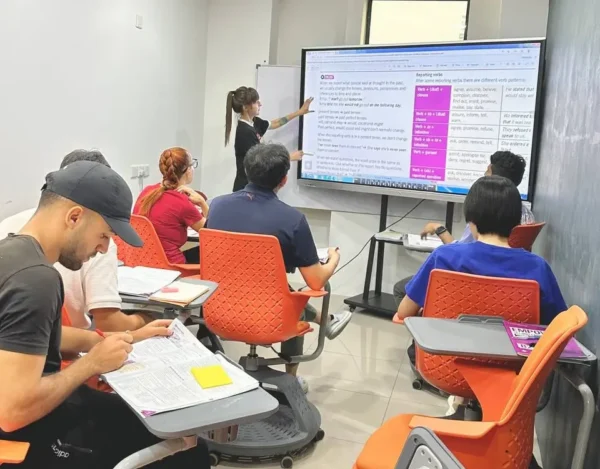
EMS says its classes are typically around 15 students. Small-group teaching can make it easier to rotate partners, receive feedback and participate more frequently than in a large lecture-style class.
A Mix of Nationalities Encourages English Use
EMS serves local and international learners in Kuala Lumpur. In a multilingual classroom, English becomes the shared language between students who may not have the same first language.
That matters for speaking development because it reduces the temptation to switch back to your own language when a sentence becomes difficult. You learn to explain, rephrase and keep communication moving.
WHAT CAN IMPROVE AFTER A MONTH?
Speaking progress is usually gradual rather than dramatic. After consistent practice, useful signs of improvement include answering more quickly, speaking in longer stretches, translating less, recovering more easily after mistakes, using a wider range of phrases and feeling more comfortable with unfamiliar partners.
Do not judge improvement only by whether you still feel nervous. Confidence can lag behind skill. Compare what you can actually do: Can you explain an opinion for two minutes? Can you ask a follow-up question without preparing it? Can you correct yourself and continue?
HOW IS A SPEAKING CLASS DIFFERENT FROM GENERAL ENGLISH?
General English develops a wider mix of language skills, usually including reading, writing, listening, grammar, vocabulary and speaking. A dedicated speaking class concentrates more of the lesson on oral communication, fluency, pronunciation, interaction and feedback.
If you need improvement across all four skills, compare the Speaking Course with EMS’s Intensive General English course: https://ems.edu.my/intensive-general-english/
If speaking confidence and fluency are the main gap, a dedicated speaking class may be the more focused option.
JOIN AN ENGLISH SPEAKING CLASS AT EMS
A useful speaking class should make the experience predictable enough to feel safe and active enough to create real progress. At EMS, the published course design centres on interactive communication, teacher feedback and varied speaking situations for learners at Elementary, Pre-Intermediate and Intermediate levels.
Explore the EMS Speaking Course: https://ems.edu.my/speaking-course/
Register online: https://ems.edu.my/online-application/
Comparing centres before you decide? See how to choose an English speaking class in Kuala Lumpur and the daily practice routine that supports class time.
Not sure why speaking lags behind your listening? Start with why you can understand English but cannot speak it.
FREQUENTLY ASKED QUESTIONS
How many students are in an EMS speaking class?
EMS currently states in its general FAQ that classes are typically around 15 students. Actual class size can vary. The Speaking Course uses interactive activities, so students can practise through pair, group and individual speaking tasks rather than only listening to a teacher.
What level of English do I need to join?
EMS currently describes the Speaking Course for Elementary, Pre-Intermediate and Intermediate learners. If you are unsure of your level, a placement test can help the academic team identify the most suitable starting point.
Will I be forced to speak in front of everyone?
Speaking practice is the purpose of the course, so you should expect to participate. However, speaking activities can include discussions, question-and-answer work, role-plays, situational dialogues and presentations, giving learners different ways to practise rather than relying on one format.
How is a speaking class different from a general English class?
A speaking class concentrates heavily on oral communication, fluency, pronunciation, interaction and feedback. General English usually spreads lesson time across a broader mix of speaking, listening, reading, writing, grammar and vocabulary.
How quickly will my speaking improve?
Progress depends on your starting level, attendance, how actively you participate and how much English you use outside class. Look for practical changes such as shorter pauses, longer answers, clearer pronunciation and less mental translation rather than expecting instant fluency.
About the author
Yulia Karmanova teaches English at EMS Language Centre in Kuala Lumpur. She holds a PhD in Linguistics and a Master’s Degree in Teaching English, Literature and Translation, and has 17 years of classroom experience.