
Accommodation is the decision students spend the least time on and complain about the most.
It usually gets made in twenty minutes, from photographs, from another country, before anyone has any real sense of how far the place is from the school or what the rent actually includes. Then the student arrives, discovers the commute is forty minutes each way on a good day, and spends the rest of the course wishing they had asked two more questions.
Kuala Lumpur has genuinely good options at most budgets. The difference between a good choice and a bad one is rarely the price. It is distance, what is included, how long you are tied in, and whether you will end up speaking any English where you live.
Four Things That Matter More Than Price
Distance From the School
Measure it in walking minutes, not kilometres, and not “close to the city centre”. Kuala Lumpur is hot and humid all year, and it rains hard most afternoons in some months. A fifteen minute walk that looks trivial on a map is a different proposition at two in the afternoon in the rain.
If you cannot walk it, work out the real door to door time including waiting. Then double it mentally for the days you are running late.
A short walk is worth more than most students expect. It saves money on transport, it saves time twice a day, and it makes the difference between going back to the school for an evening activity and staying home.
What Is Actually Included
This is where the cheapest option often stops being the cheapest. Ask specifically about electricity, water, wifi, air conditioning, bedding, towels, kitchen equipment, cleaning, and laundry.
Air conditioning matters more than anything else on that list. In Kuala Lumpur it runs most of the year, and if electricity is billed separately it can add a meaningful amount to a monthly budget that looked fine on paper.
How Long You Are Committed For
Private rentals in Malaysia are generally set up for long stays, often a year, with a deposit of typically two months of rent plus a separate utilities deposit. Confirm the exact terms with the landlord or agent, because they vary.
If you are here for four weeks, a standard rental is not built for you, and trying to force it usually costs more than the flexible option would have. If you are here for six months, the flexible option is the expensive one.
Who Else Lives There
The thing nobody asks about, and the thing that most affects your English. More on that below, because it deserves its own section.
The Five Options
School Provided Apartments
Apartments arranged by your language school, usually shared, usually close to the campus.
The advantages are practical. Someone has already checked the place, the contract is designed around course lengths rather than annual leases, you can arrange it before you fly, and if something breaks there is a person at the school to tell. For a first stay in a new country, that support is worth paying a little more for.
The trade off is less choice and less independence. You get what the school has available, and you live alongside other students from the same school, which is either the main attraction or the main drawback depending on your temperament.
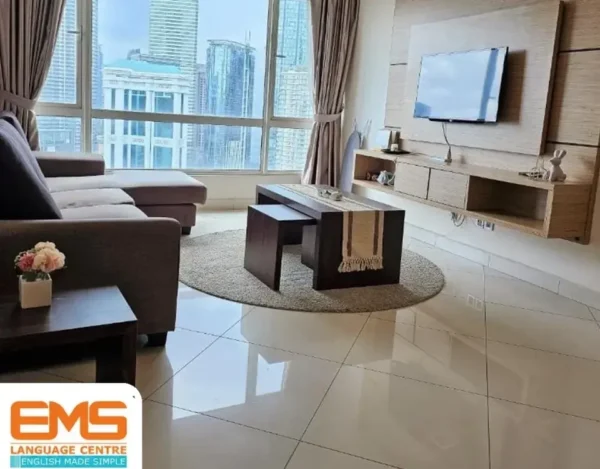
EMS arranges student accommodation in the city centre within walking distance of the school. Its own published figures put this at RM 800 to RM 2,700 per month for shared or private options, depending on room size, whether the bathroom is private or shared, and the season. Those figures were published in May 2026, and for long stay students prices are usually fixed in the contract rather than moving with the season. Confirm current rates directly.
Private Rental
Renting a room or a whole unit yourself, through an agent or a listings site.
This gives you the most control over where you live, who you live with, and what you pay. In a city with as much apartment stock as Kuala Lumpur, that choice is real, and for a longer stay it is usually the cheapest route per month.
It is also the most work and the most risk. You are viewing places yourself, negotiating yourself, signing a contract in a legal system you may not know, and paying a deposit to someone you have not met. Doing that from abroad before you arrive is how students get caught out. If you go this route, plan to arrive first, stay somewhere flexible for a week or two, and view places in person.
Co-living Spaces
Purpose built shared housing with private bedrooms, shared kitchens and lounges, and rent that bundles utilities, wifi, and cleaning into one figure.
Kuala Lumpur has a reasonable supply of these and they suit students well. Contracts are usually shorter and more flexible than a standard rental, the bundled bill removes the electricity surprise, and the shared spaces are designed to be used, which makes meeting people easy.
The cost usually sits above a comparable private room and below a serviced apartment. You are paying for flexibility and convenience, which for a three month course is often a sensible thing to buy.
Hostels and Guesthouses
Best understood as a short term tool rather than a place to live.
For the first week while you view apartments, or for a two week course, a hostel is cheap, immediate, and requires no contract. It is also noisy, has no private space, and gets old quickly. Almost nobody enjoys their sixth week in a hostel.
Use them deliberately: as a landing spot, not a plan.
Homestay With a Local Family
Living with a Malaysian family, usually with some meals included.
For English practice and cultural immersion this is the strongest option on the list. You get daily conversation with people who are not language students, you eat food you would not have found on your own, and you see how the city actually works.
The trade offs are independence and location. House rules apply, you are fitting into someone else’s routine, and families are more often in residential suburbs than in the city centre, so the commute is usually longer. Availability is also limited compared with the other four.
Comparison Table
| Option | Typical commitment | What is usually included | Distance from school | Independence | Best for |
|---|---|---|---|---|---|
| School apartment | Matched to course length | Usually furnished, bills often included, support from the school | Usually walking distance | Moderate | First time abroad, short and medium stays, students who want it sorted before arriving |
| Private rental | Often 6 to 12 months | Unfurnished or partly furnished, bills usually separate | Whatever you choose | High | Long stays, students already in the city, confident renters |
| Co-living | Often 1 to 6 months | Furnished, bills, wifi and cleaning bundled | Varies, often central | Moderate to high | 2 to 6 month stays, students who want flexibility without hassle |
| Hostel or guesthouse | Nightly or weekly | Bed, wifi, shared everything | Varies | Low | The first week, or a very short course |
| Homestay | Monthly | Room, often meals, family life | Often further out | Low | Maximum English immersion and cultural experience |
What Each Option Really Costs Per Month
The Published Ranges
EMS’s published breakdown for Kuala Lumpur in May 2026 put accommodation at RM 800 to RM 2,700 per month for its school apartments, alongside food at RM 1,000 to RM 2,000 and tuition at RM 2,050 to RM 3,250, giving a total monthly cost of roughly RM 3,850 to RM 7,950. The full breakdown is in what one month of studying English in Kuala Lumpur costs.
Those are May 2026 figures. Costs move, so confirm current rates before budgeting on them.
Market rates for private rental, co-living, and homestay change too often to state responsibly in an article you might read a year from now. Check current listings when you are actually booking. As a rule of thumb, a shared room in a private rental is normally the cheapest per month on a long contract, co-living sits in the middle and buys you flexibility, and hostels are cheapest per night and the most expensive per month.
The Costs People Forget
- Deposits. Private rentals typically ask for around two months of rent plus a utilities deposit, paid before you move in. Budget for it as cash you will not see again until you leave.
- Electricity. Air conditioning is the single largest variable in a Kuala Lumpur utility bill.
- Transport. A cheap room forty minutes away has a daily cost attached to it.
- Furnishing a bare unit. Bedding, kitchen equipment, and a fan add up fast, and you cannot take them home.
- Agent fees, where an agent is involved.
- The overlap. If you stay in a hostel for a week while viewing apartments, that week is an extra cost, and it is usually worth paying.
Where to Live in Kuala Lumpur as a Student
Living Close to the School
City centre living costs more per square metre and less in every other way: no commute, no transport spend, no forty minute journey home after an evening class. You are also surrounded by cafés, food courts, shops, and public transport, which is where a lot of your unplanned English practice will happen.
For a course of a few weeks or a few months, this is usually the right answer.
Living Further Out to Save Money
Rent drops as you move out from the centre, and for a long stay on a tight budget that saving is real. Kuala Lumpur has an extensive rail network of LRT, MRT, and monorail lines, and living near a station makes a longer distance manageable.
The rule is simple: if you are going to live further out, live near a station. A cheap apartment that needs a bus and a train is not cheap.
Why the Transport Maths Usually Loses
Students who move further out to save money often calculate the rent saving and forget everything else. Add up the transport cost, and then add the days you skip an optional evening activity because it means an hour of travelling, and the days you eat something expensive near the school because going home and coming back is not worth it.
The saving is often smaller than it looked, and the course is often worse. If the difference is modest, stay close.
Short Stays Versus Long Stays
One Month or Less
Go with the school apartment or a co-living space, and book it before you arrive. There is no time to search for something better, and a private rental will not want you for four weeks. Flexibility is worth paying for at this length.
Three Months or More
Now it is worth doing the work. Consider arriving into school accommodation or a co-living space for the first few weeks, using that time to view private options in person, and moving once you know the city. You will make a much better decision in week three than you could have made from abroad.
Why Long Stay Contracts Are Usually Cheaper
Monthly rates almost always fall as the commitment lengthens, and EMS’s own published note is that long stay prices are usually fixed in the contract rather than moving with the season. If you already know you are staying six months, say so upfront and ask what the rate is for the whole period rather than booking a month at a time.
The English Factor Nobody Plans For
Living With People Who Share Your First Language
Here is the scenario that plays out constantly. A student arrives, finds a room in a flat with three others from their own country, and it feels like a relief. Someone explains how the washing machine works in their own language. The first week is far less lonely.
Then, four weeks later, they are frustrated that their English is not improving as fast as they expected. They are in class for a few hours a day and speaking their first language for the rest of it.
This is not a discipline failure. It is arithmetic. If sixteen of your waking hours are in your first language, the four in English are doing all the work.
Why Where You Sleep Affects How Fast You Improve
The students who improve fastest are almost always the ones who cannot avoid English at home. Not because they are trying harder, but because the environment does the work for them: a flatmate from a different country, a host family, or a co-living space where the shared kitchen is a mix of nationalities.
None of this means you should avoid people from your own country. Having someone who understands exactly what you are dealing with matters, especially in the first fortnight.
It means one question is worth asking before you sign anything: who else lives here, and what language will we speak to each other? If the honest answer is your own language, you have not chosen accommodation, you have chosen how much English practice you get for the whole course.
This is one reason a mixed nationality school helps. The classroom and the corridors do some of the work, and living close to the school extends that further into your day. There is more on this in practising English outside the classroom.
Questions to Ask Before You Pay a Deposit
How Far Is It From the School, Walking?
Ask for the number of minutes on foot, not the distance and not a description. If it is not walkable, ask for the door to door time by public transport at eight in the morning.
What Is Included in the Price?
Electricity, water, wifi, air conditioning, bedding, kitchen equipment, cleaning, laundry. Ask about each one rather than asking whether “bills are included”, because the answer to the general question is often less accurate than the answer to the specific one.
What Is the Deposit and Refund Policy?
How much, when it is paid, what triggers a deduction, and how long the refund takes after you leave. Get it in writing. This is the single most common source of disputes for students in any city.
Can I See the Actual Room?
The actual room, not the show unit and not a photo of a similar one. If you cannot visit, ask for a video walkthrough taken now. A reasonable landlord or school will provide one. Reluctance to do so is information.
What Happens If I Extend My Course?
Many students extend. Ask what happens to the rate and to your room if you do, and whether you can stay in the same place, because moving mid course is a distraction you will not want.
Five Accommodation Mistakes International Students Make
Booking a twelve month lease for a three month course. The monthly rate looks great, and then leaving early costs the deposit.
Choosing on photographs alone. Photographs are taken with a wide lens on the brightest day of the year. Ask for a video.
Ignoring the commute. Forty minutes each way is thirteen hours a month of your course spent travelling.
Forgetting the electricity bill. Air conditioning in Kuala Lumpur is not an occasional luxury.
Moving in with people who speak your language, then wondering why the English is slow. The most expensive mistake on the list, and the one nobody warns you about.
Accommodation at EMS
EMS Language Centre arranges student accommodation in the city centre within walking distance of the school, with shared and private options. Because the apartments are arranged through the school, the contract fits the length of your course, everything is set up before you land, and there is somebody at the school to tell when the air conditioning stops working.
For students arriving in Kuala Lumpur for the first time, that combination of a short walk and a person to ask is usually worth more than a slightly cheaper room further out.
If you are planning your budget, the full monthly cost breakdown covers tuition, accommodation, and food together. If you are still working out visas and paperwork, see the student visa requirements guide, and how to apply for the enrolment process.
Register and Ask About Accommodation
Accommodation is worth twenty more minutes than most students give it. Ask how far it is on foot, ask what is included, ask what the deposit rules are, and ask who else lives there and what language they speak.
EMS Language Centre has taught English in central Kuala Lumpur for over fifteen years and arranges accommodation for international students within walking distance of the school. If you are not sure which option suits your course length and budget, contact EMS and ask before you book anything.
Register now: https://ems.edu.my/online-application/
Frequently Asked Questions
How much does student accommodation cost in Kuala Lumpur?
It depends on the type of accommodation, the room, and the season. EMS published a range of RM 800 to RM 2,700 per month for its own school apartments in May 2026, covering shared and private options. Private rentals, co-living spaces, and homestays vary widely, so check current listings when you book. Remember to budget for deposits and for electricity if it is billed separately.
Is it better to book accommodation through the school?
For a first stay, usually yes. The place has been checked, the contract matches your course length, it is arranged before you arrive, and there is somebody to contact if something goes wrong. Private rental can be cheaper per month on a long contract, but it works best once you are already in the city and can view places in person.
Can I find short term accommodation for a one month English course?
Yes. School arranged apartments, co-living spaces, and hostels all take short stays. Standard private rentals generally do not, since they are set up for much longer commitments, so a one month course is not the time to try to arrange one.
Which areas of Kuala Lumpur are best for students?
The best area is the one within walking distance of your school, or failing that, near a rail station on a direct line to it. Kuala Lumpur has an extensive LRT, MRT, and monorail network, so proximity to a station matters more than the name of the neighbourhood. Central areas cost more in rent and less in commuting.
Do I need to pay a deposit for student accommodation in Malaysia?
Usually yes. Private rentals commonly ask for around two months of rent plus a separate utilities deposit, and school arranged accommodation normally asks for a deposit too, though terms differ. Ask exactly how much, when it is due, what can be deducted, and how long the refund takes after you leave, and get the answer in writing.
Should I book accommodation before arriving in Malaysia?
Book something before you arrive, always. Whether that is your accommodation for the whole course or just the first two weeks depends on how long you are staying. For a short course, book the whole stay. For several months, consider booking school or co-living accommodation first and viewing private options in person once you know the city.